A BRIEF INFORMATION ABOUT TURKEY AND IT'S GAY LIFE
UNDERSTANDING GAY CULTURE OF TURKEY WITH WORDS:
For the gay people who have not visited Turkey before,
the first step should be getting familiar with the gay
culture. The gay culture of Turkey is fairly different
than the gay culture of the western countries, as is
the case with the general Turkish culture. Turkey,
being situated at the intersection of Europe and Asia
geographically, was effected both by the western and
oriental cultures. Turkey is the only Muslim country
where homosexuality is not illegal. This makes Turkish
gay life unique in the world. This difference might be
good or bad depending on your expectations, but one
thing is for sure: It is very vivacious and
interesting.
Note that we avoid to cause another misunderstanding
with above explanation, because in the west there is
already a very big misunderstanding about Turkish
culture. Surprisingly, some people in the west still
think of Turkey as a very typical and traditional
Middle-Eastern country and some of them even think
Turkey is just like other Arabic countries and the
religion is dominating everything. In reality, Turkey
has got a special culture of her own, much closer to
the Western culture than most other Middle Eastern
countries, except her incorrigible economy maybe.
To understand the gay life in Turkey, let's analyze
two Turkish words: "ibne" and "oglan". Actually, both
words literally mean "boy" although they are now being
used as expression of insult. "Ibne" is originally
exported from Arabic and it is being used with a
meaning very close to "faggot" in today's Turkish.
Although "oglan" means exactly "boy" in formal
Turkish, it is often being used to mean "gay" in slang
language. Their present meanings' got a historical
background:
As we all know, a boy is not a man, not hairy, without
beard, with a voice more like a woman, he's got a
softer skin etc....As you can easily notice, these are
all descriptions of a woman. Especially at times when
religion was stronger, a boy could probably be the
substitution of a woman. This might be a key to
understand the remains of the history in modern
Turkish gay culture. Today, the dominating gay-life
style for the gay people living in Turkey is between
two groups; the "active" ones who would NOT mostly
accept to be called "gay" and who are mostly
bisexuals, and the "passive" ones who pretend to be
women in bed, and who act and sometimes dress
themselves up more effeminately. So the first question
after meeting a gay-related person might very possibly
be "Are you passive or active (bottom or top) ?"
Spreading use of the English word "gay" also is an
indication of changing gay culture in recent years.
Other people are also getting more conscious about gay
people and accepting their different sexual identity
more. But still there's a long way to go, and maybe
it's questionable which life style is better.
Maybe, these different cultures might be considered as
an advantage for gay people in Turkey in a way, since
they have at least the two alternatives to choose as
their life styles.
Turkey Facebook Group
Please hit
the like button to join our Facebook gay group,
after which you can post comments, interact with other
gay people from Turkey and all over Turkey, make new
friends and get latest news about Turkish gay life.
Join the Conversation
You
can write your messages below about anything concerning gay
life in whole of Turkey by means of your Facebook,
Twitter, Google+, Disqus accounts; as well as
anonymously as a guest (to be moderated). Please kindly note that use
of bad language, obscene words, pornography, discrimination, racism,
hate speech etc. etc are not allowed on our websites.
Please
login to your
Facebook Account to be able to see below content
Book
your hotel from leading gay travel agency of Turkey.
Not surprisingly, there are not many gay / gay-friendly
hotels in Turkey, but it may still be wise to ask
recommendation of local gay people in the business. This
gay-owned Turkish Travel agency is trying hard to
developed gay tourism in Turkey and you can also help them
by using their service
Gay & lesbian Internet Sources for Turkey: Here is a list of internet sources which may help you
communicate with other gay / lesbian people form Turkey and other
cities of Turkey:
LGBT Turkey - Facebook Community
Facebook Community Page Combining Turkish Gays. You can join the
group by hitting the "like button". You can leave messages to
contact other gay men.
Turkey Gay Tours - Facebook Page
Facebook Page
of Turkey's first openly gay travel agency. Besides travel
related posts you can also follow all kind of LGBT activities in
Turkey if you join the page. You can also interact with other
gay men on the page.
Google Group for Turkish LGBT
A Yahoo Group to meet Turkish gay men from all over Turkey. You
can leave a message to meet Turkish gays and gay tourists living
in or visiting Adana in this group Everyday Turkey Tours Turkey tour by reputable travel agency.
A class certified, reputable travel agency located at the center
of historical downtown Sultanahmet, Istanbul. They offer private
or group daily tours, blue cruises, affordable package tours all
around Turkey.
TURKEY GAY GUIDE
Turkey Gay Travel Guide of Major
Cities - Gay bars, clubs, restaurants, cafe shops,
hamam, sauna and bath houses, gay beaches, gay friendly
hotels, tours, cruises in major cities of Turkey
-
Click here for Turkey Gay Guide
TURKEY
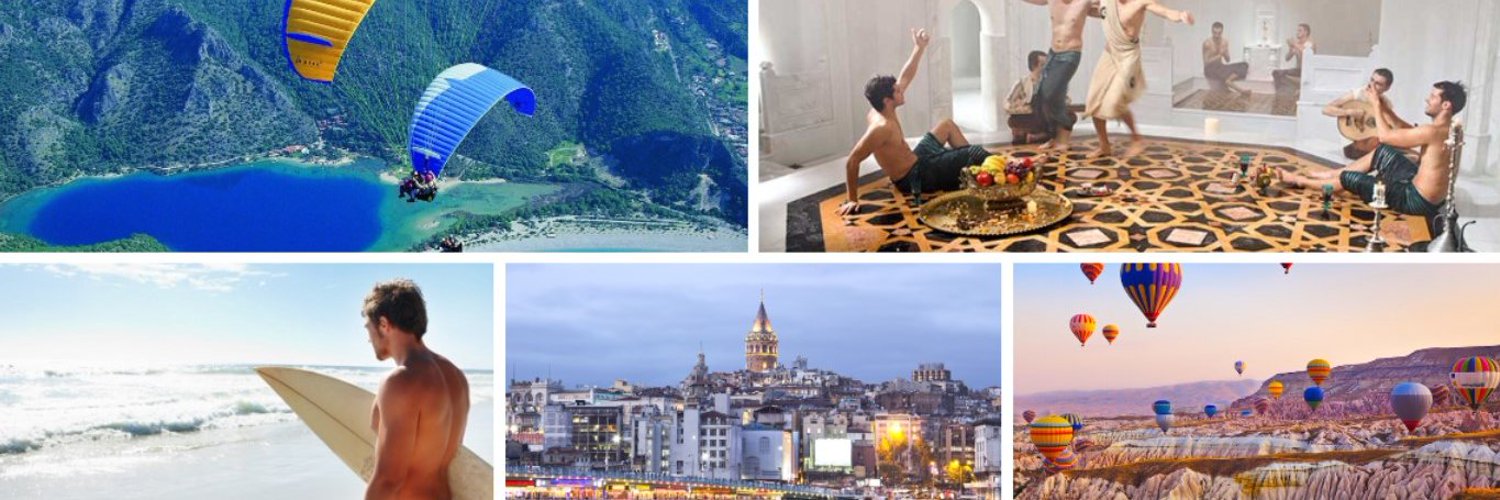
Knocking at Europe's door yet on the threshold of Asia, Turkey
is truly a land of contrasts. Here you can scale the icy heights
of remote Mount Ararat in search of Noah's Ark, cross the
historic Euphrates and Tigris rivers, follow in the footsteps of
St Paul or simply relax on the golden Mediterranean sands of
Patara beach. Vibrant Istanbul, straddling the blue waters of
the Bosphorus separating Europe from Asia, beckons with its
skyline pierced by countless minarets, chaotic bazaars and a
history redolent with harem intrigue and despotic Sultans.
In Turkey, you can also cruise along more than a thousand
kilometers of Mediterranean coastline, past secluded coves,
rocky headlands and pretty fishing villages, or explore a
hinterland rich in the wonderfully preserved remains of
Greco-Roman cities such as Ephesus. For the adventurous, the
austere beauty of the Anatolian plateau, the surreal
rock-chimney landscape of Cappadocia and the atmospheric ruins
of the enigmatic Hittites await discovery. Here, too, is the
unique experience of watching the dervishes whirl in pious Konya.
With a code of hospitality nurtured by their Islamic beliefs yet
with a remarkable tolerance of other customs, the Turks offer a
warm welcome wherever you travel - be it sipping sweet black tea
or thick coffee with friendly villagers or sharing a bottle of
raki over mezes (hors d'oeuvres) with cosmopolitan Istanbul
'city slickers'.
Travel - International
AIR: Turkey's national airline is Turkish Airlines (THY).
Approximate flight times: From Frankfurt/M to Istanbul is 2
hours 45 minutes, from London is 3 hours 30 minutes and from New
York is 11 hours.
International airports:
Ankara (ESB) (Esenboga) is 35km (22 miles) northeast of the
city. THY buses go from the city 90 minutes before domestic
flights and 135 minutes before international flights. There is a
taxi service available into the city. Airport facilities include
incoming and outgoing duty-free shops; bank/bureau de change;
restaurant and bar.
Istanbul (IST) (Ataturk, formerly Yesilkoy) is 24km (15 miles)
west of the city (travel time - 30-50 minutes). A coach (THY
bus) goes every 15 minutes to the THY terminal. There are taxi
services to the city. Airport facilities include incoming and
outgoing 24-hour duty-free shop; bank/bureau de change;
restaurant; bar and car hire (Avis, Budget, Hertz and Europcar).
Sabiha Gokcen (SAW) is 40km (25 miles) from the city, on the
Asian side. It is Turkey's newest international airport, and
opened on January 8 2001. There are shuttle bus services to the
city (journey time - 30-45 minutes) and to Atatürk International
Airport (journey time - 60-70 minutes). Taxis are available 24
hours a day. Facilities include duty-free shops, bank, cash
dispensers, business centre and restaurants/cafés.
Izmir (IZM) (Adnan Menderes). A THY bus leaves from the city 75
minutes before departure. Airport facilities include bank/bureau
de change; restaurant and bar.
There are other international airports at Gaziantep, Adana,
Trabzon, Dalaman and Antalya.
SEA: Major ports are Istanbul, Izmir, Marmaris, Mersin,
Antalya and Bandirma. Turkish Maritime Lines (TML), the national
shipping organisation, and a number of cruise lines run services
to Turkey, including: Golden Sun Cruises, Epirotiki, Linblad
Expeditions, Costa, CTC, Norwegian, 'K' Lines and Sun Line.
Several ferry routes are available: To/from Italy: Ferries
operate between Venice-Izmir, Venice-Antalya/Marmaris,
Venice-Istanbul via Pireaus and Brindisi-Cesme. To/from Cyprus:
Three routes exist on which sea buses, together with car and
passenger ferries, operate: Alanya-Girne and Tasucu-Girne and
Gazimagosa-Mersin. To/from Greece: There are privately operated
ferry lines between Turkey and the Greek islands: Lesbos (Midilli)-Ayvalik,
Chios (Sakiz)-Cesme, Samos (Sisam)-Kusadasi, Cos (Istanköy)-Bodrum,
Rhodes (Rodos)-Marmaris, Sömbeki (Symi)-Datça.
Note: All ships, including private yachts, arriving in Turkish
waters must go to one of the following ports of entry:
Canakkale, Bandirma, Istanbul, Akcay, Ayvalik, Dikili, Izmir,
Cesme, Kusadasi, Güllük, Bodrum, Datca, Marmaris, Fethiye, Kas,
Finike, Kemer, Antalya, Alanya, Anamur, Söke, Tasucu (Silifke),
Mersin, Iskenderun, Samsun, Trabzon, Botas (Adana), Didim,
Derince, Tekirdag, Giresun, Rize, Sinop, Ordu, Zonguldak or Hopa
(Artvin).
RAIL: There are connections from London (Liverpool
Street) via Hook of Holland and Cologne to Istanbul on the
Istanbul Express, which also carries cars from several other
European cities. There is a weekly sleeper from Moscow.
InterRail tickets are available in the European part of Turkey
as far as Istanbul. Other international rail routes go to
Germany, Greece, Bulgaria, Yugoslavia and Georgia. For more
information contact Turkish Railways (TCDD) in Istanbul (tel:
(212) 527 00 50/51; reservations: (212) 520 65 75).
ROAD: There are roads from the CIS, Greece, Bulgaria and
Iran. Drivers may either choose the northern route of Belgium,
Germany, Austria, Hungary, Romania, and then Bulgaria, or the
southern route through Belgium, Austria and Italy with a
car-ferry connection to Turkey. Coach: There are regular
services between Turkey and Austria, France, Germany and
Switzerland as well as Jordan, Iran, Saudi Arabia and Syria.