|
|
 |
|||||
|
|||||
|
|||||
|
|
|||||
|
|
|||||
|
Something you will enjoy in Bursa are the warm, mineral-rich springs; indeed most of the hotels in this province have thermal bath facilities. The Turkish baths "hammam" are great places which should be visited in Bursa. The Eski Kaplica (Old Spring) is the oldest in the province. The Kara Mustafa Pasha Baths are famous, and boast the best hot, mineral waters. As for souvenirs, you should visit the Covered Bazaar, "Bedesten", or the Koza Han-an attractive building and also a center of silk trade. It is certain that Bursa will take some of time for you to see and add some more delightful experiences to your memories. Environment: Uludag is the largest and most celebrated winter-sports center in Turkey. It is 36 kms from Bursa and easily accessible by car or cable-car (teleferik). The area is also a national park and is worth a visit at any time of the year. The accommodation is high quality offering the opportunity to enjoy, with a variety of entertainment and sports activities. Mudanya is a seaside resort town from fine fish restaurants and night-clubs there so you can have a pleasant Zeytinbagi (Trilye) is a town of typical Turkish architecture and lay out. There are sea bus and ferry connections with Istanbul. Gemlik (27 km north), is another seaside resort with a wide, sandy beach.
Iznik (Nicaea) lies
85 kms northeast of Bursa, at the eastern tip of Lake knik. The town has
witnessed many civilizations which have left their marks all over the land.
This town is famous for its unique tiles and has been the center of
tile production in the 16th century. Iznik tiles were the basic decorative
element of Seljuk and Ottoman architecture. The turquoise-tiled Yesil Mosque
and Nilufer Hatun imareti are among the Islamic works in the town |
|||||
|
|
|||||
|
|
|||||
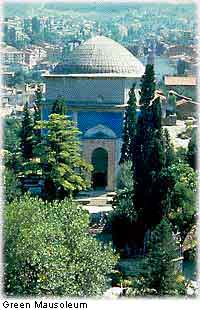 Known
as "Green Bursa", this province stands on the lower slopes of Uludag
(Mount Olympos of Asia, 2543 m). Because of its being the first
Ottoman capital, Bursa is very rich in religious monuments, mosques, and
tombs (turbes), baths. One of the places to be seen in Bursa is the Yesil
Mosque (Green Mosque), with its carved marble doorway which is one of the
best in Anatolia. It is an elaborate and significant building in the new
Turkish style. Just opposite, is the Yesil Tomb "Green Tomb", set in
a green garden with an enchanting exterior decorated with turquoise tiles.
Near the tomb, the Medrese complements the others and makes this the "green"
trio, now it houses the Ethnographical Museum which certainly deserves
visiting. The Yildirim Beyazit Mosque is important as it is the first one
built in the new Ottoman style and is accompanied by the Emir Sultan Mosque
which lies in a peaceful setting. The province is decorated with these
monuments-each of which is a masterpiece. Here are the Ulu Mosque built in
the Seljuk style, with impressive calligraphic wall decorations; the Orhan
Gazi Mosque; the "Hisar" an attractive part of the province, and in the park
the Mausoleums of Osman, the founder of the Ottoman Empire,
and his son Orhan Gazi. The Muradiye Complex has a delightful view with its
mosque and tombs of important characters from the Ottoman era and their
tiles and charming decorations appeal to the sightseers. The Ottoman
Museum offers a lively exhibit of the traditional life style of Ottomans.
Known
as "Green Bursa", this province stands on the lower slopes of Uludag
(Mount Olympos of Asia, 2543 m). Because of its being the first
Ottoman capital, Bursa is very rich in religious monuments, mosques, and
tombs (turbes), baths. One of the places to be seen in Bursa is the Yesil
Mosque (Green Mosque), with its carved marble doorway which is one of the
best in Anatolia. It is an elaborate and significant building in the new
Turkish style. Just opposite, is the Yesil Tomb "Green Tomb", set in
a green garden with an enchanting exterior decorated with turquoise tiles.
Near the tomb, the Medrese complements the others and makes this the "green"
trio, now it houses the Ethnographical Museum which certainly deserves
visiting. The Yildirim Beyazit Mosque is important as it is the first one
built in the new Ottoman style and is accompanied by the Emir Sultan Mosque
which lies in a peaceful setting. The province is decorated with these
monuments-each of which is a masterpiece. Here are the Ulu Mosque built in
the Seljuk style, with impressive calligraphic wall decorations; the Orhan
Gazi Mosque; the "Hisar" an attractive part of the province, and in the park
the Mausoleums of Osman, the founder of the Ottoman Empire,
and his son Orhan Gazi. The Muradiye Complex has a delightful view with its
mosque and tombs of important characters from the Ottoman era and their
tiles and charming decorations appeal to the sightseers. The Ottoman
Museum offers a lively exhibit of the traditional life style of Ottomans.
*